Your Exposome is Your Future

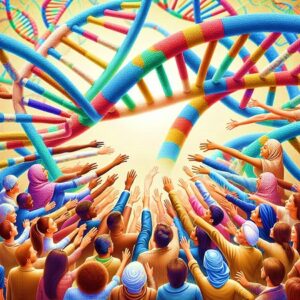
While your inherited DNA is fixed at the point of conception, the exposome–the totality of everything you are exposed to from conception onward (also referred to in behavioral genetics as the environome)–is written on a daily basis, throughout one’s lifetime.8
Some of your exposome is written by you while most of it is written by others.
Why is this important?
Most of these others are institutions.
Unlike the genome, which is passed down through discrete units of DNA, the environment has no natural biological unit of transmission. Instead, institutions supply the mechanism of inheritance. Through laws, property regimes and policies, institutions sort people across generations into durable socioeconomic niches…neighborhoods, schools, jobs and pay grades biased by the social preferences of those who design and build them.
Over generations, the sorting process begins to look natural, resulting in false beliefs that the privileges of the advantaged are the result of genetic-based merit.
This is the hard problem of human individual differences and well-being…Every person’s wish for a long, healthy, happy and purposeful life is inescapably linked to institutions in their exposome.
Research has shown a person’s inherited DNA, on its own, does not determine life course outcomes.1 This is why eugenics has a dark legacy.
The poet William Blake sharpens the persistent and unrelenting nature of the hard problem across generations:2
Every night and every morn
Some to misery are born.
Every morn and every night
Some are born to sweet delight.
Some are born to sweet delight,
Some are born to endless night.
The Universal Declaration of Human Rights begins by recognizing “the equal and inalienable rights of all members of the human family.”3
In this article we argue that these are, in essence, exposome rights…rights that are personally inalienable, institutionally stewarded and collectively beneficial.
A Problem
Today, who is in the strongest position to own, control or appropriate another person’s exposome? The answer is clear…whoever or whatever has the income, wealth and power to make and enforce their claim using institutions as the instrument of power.
At the top of the socioeconomic pyramid are individuals with excessive wealth whose influence and power shapes environments and exposomes to fit their social preferences.
While an individual’s genome does not fix social outcomes in advance, institutions often use partly heritable traits as the instrument of sorting, deeply affecting each person’s life course outcomes and well-being.
Moreover, because institutions impose exposures that interact directly with individual genetic propensities, institutional sorting inherently operates through the interplay of genes and environments.
For example, recent research in behavioral genetics has demonstrated how the complex interplay of each person’s genetic propensities and environments results in people actively evoking, creating, modifying and selecting into environments4 that more closely align with their genetic propensities,5 forming groups and coalitions that often serve as vehicles for hierarchy and social dominance6 in a competition to influence and control how norms and institutions regulate the distribution of resources and power.7
In behavioral genetics, active gene-environment correlation (rGE) is where individuals seek, create and modify environments that fit their genetic propensities.
While active rGE on an individual scale is a natural developmental process, active rGE becomes a mechanism of stratification when dominant groups with concentrated income, wealth and power create and modify environments at the scale of a society, institutionalizing their preferred environments into rules and laws that create quality life gradients and inequities across the exposomes of billions of people.
Throughout the world, extreme wealth translates into inflated political influence that can corrupt the democratic principle of equal representation.9 How can a democracy work if the exposomes of its citizenry is owned by a select group of individuals?
From a historical perspective, the power to own and control exposomes comes in many different forms.
For example, from governance to workplace structures, corporate controls over supply-chains, advertising and media influence, urban planning, access to transportation, zoning, food system distribution, debt, credit access, military, police and legal authority.
This is the history of human civilizations…strewn with big men, chiefs, kings, tyrants, despots, oligarchs and plutocrats rising in power by controlling and owning the exposomes of those they rule.
Personally Inalienable, Institutionally Stewarded, Collectively Beneficial
The power to control one’s exposome can also become the power to control other people’s exposomes to fit one’s social preferences. When that power becomes concentrated, exposome interventions can lock people into life course trajectories they would otherwise not choose.
This requires governance with stewardship obligations.
Without stewardship each person’s exposome becomes vulnerable to the socioeconomic inequities of genetic determinism by default, system-justified harms and Equality Exclusions (EQEXs).
Every political and economic system distributes and justifies exposome exposures as surely as it distributes income. The duty to justify and remedy unfairness and injustice, to make certain such exposures are ‘institutionally stewarded’ and ‘collectively beneficial’ falls on the governments and corporations that impose them.
It is proposed here that no one should impose such interventions and exposures without a justification the person who must bear the imposition could not reasonably reject.
Moreover, because many of life’s most consequential exposures arrive in childhood…imposed by others and bundled with a child’s genetic propensities through passive gene–environment correlation…a child’s exposome can become locked.
This is where genetic determinism by default enters the picture: early lock-in and closure make outcomes hard to reverse. While a life free of conflict in a world of varying traits and dispositions is not possible, there are solutions to these life course dissensions if every person’s exposome has secure floors and high ceilings.
While governments and corporations inevitably shape and steward environmental exposures, they must be prevented from exploiting or exerting proprietary ownership over an individual’s exposome. This means researchers, employers, insurers, platforms and governments have a fiduciary responsibility not to prioritize their own exposome over the welfare and exposome of others.
Moreover, gene-environment interactions (GxE) add another layer of fiduciary and stewardship responsibilities because the same environmental exposure can result in positive or negative life course effects based on differences between individuals in their genetic propensities.
Cultural, historical, political, economic, natural and biophysical factors are dynamic and interwoven environmental conditions and not isolated variables in each person’s exposome such that no person should be denied the right to challenge how these environmental factors shape their life course outcomes. In this sense, the exposome of every human being, collectively, is a global public good.
Limits and Stakes
Some people need far more than others to have a long, heathy, happy and purposeful life. Inherited disabilities are but one example. Governance should not eliminate expensive or costly needs while expensive tastes and desires need caps or ceilings. Understanding the difference invokes a gene-environment perspective.
Moreover, individual active gene-environment correlation is not the adversary…the adversary is its institutional capture through the system-justified harms and EQEXs that dominant groups and coalitions attach to it.
Importantly, while heritability may rise as socioeconomic barriers fall, this should not imply failure because genetic determinism by default locates injustice in low institutional reversibility (stratified exposomes) not in heritability.
History’s jack-in-the-box pattern of rising and falling hierarchies suggests why exposome rights must be inalienable…otherwise the alternative is a cyclical pattern of leveling that leads to catastrophe.
Every coalition that rises in power rewrites the rules of exposure in its favor. Any system that shapes and manages exposomes, AI included, will be captured unless its core lies beyond their reach.
This is the framework of the next article: AI & Your Exposome.
Last edited: October 2026