The Gene-Environment Paradox: Human differences in cognition, behavior, moral judgments and social preferences emerge from the interplay between genetic propensities and environmental conditions.3 The result is a paradox–the paradox of the right and the good–what is considered “right” or “good” varies due to the gene-environment complexities of the interplay.4
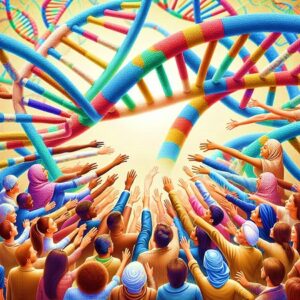 This isn’t mere disagreement…it reflects genuine genetic and neurological differences as to how people compute fairness, risk and moral judgment.
People have different talents, abilities, life course goals, desires and outcomes shaped by an interplay between their genetic propensities and environmental conditions (e.g., social, political, economic, natural and biophysical).3
Fundamental to these differences are social conflicts over resource distribution and well-being due to differences between individuals in their social, political, economic and moral assessments of ‘right’ and its relationship to what is considered ‘good’.
The paradox leads to a competition to create, arrange and select into environments that more closely align with one’s genetically-shaped social preferences.3
While individuals naturally attempt to select into environments that align with their genetic propensities, those that sit at the top of the hierarchy can use their income, wealth and power to monopolize and institutionalize their own optimal environments, structurally trapping those in the lower socioeconomic tiers of the hierarchy.5,6
Furthermore, because conflicts over political beliefs and resource distribution are partly heritable they are biologically rooted, not merely superficial disagreements.7 Instead, these conflicts are shaped by how heritable variation interacts with social experience, influencing how individuals weigh fairness, efficiency, loyalty and risk.
System-Justified Harms: Since the emergence of the first cities and states 5,000+ years ago,8,9 social hierarchies have weaponized this variation through system-justified harms (harms that function as social and moral goods)…coercive acts such as punishment, exclusion and inequality that are framed as necessary, fair or even virtuous because they preserve the dominant group’s moral order and access to well-being. As the articles explain: When a harm functions as a social and moral good, the harm is turned into a morally right, fair, just and fully deserved punishment.
Equality Exclusions (EQEXs): System-justified harms become institutionalized through Equality Exclusions: rules, laws and policies that embed inequality into the very infrastructure of society. EQEXs make it fair, just and prosocial for individuals and groups in the upper levels of the social hierarchy to extract resources and quality life years from descending levels of the hierarchy.